 |
Been There. Done That.
BIOMASS GASIFICATION
An Alternative Automotive Fuel
Ben Russell, August 2008
In the fall of 1979, ECAR became the first conventional automobile to cross the United States powered solely by the gases from wood. Six months prior to this seemingly impossible 2,500 Mile epoch, not one of ECAR’s builder/driver team could have even recognized a wood powered gasifier.
On day one of the 180 days of explosive activity leading to this unimaginable venture, Ben Russell introduced gasification to a perplexed, but enthusiast, little group of coworkers. Having only recently heard confirmation of a long-time, but cloudy, phenomenon, Ben had just returned to Alabama from a quick jaunt to Sweden--hurriedly arranged as addenda to a European business trip. Significant insight was gleaned into this seemingly mysterious quirk of nature -- A principal that, in all benevolence, had allowed millions to survive Europe’s darkest war years.
Within a week of returning, however, the haphazardly assembled group was well into “some sickening form of the ritualistic practice of pyromania.” Another early follower noted it to be “terribly ill suited for summer activity.” All in all, however, progress was slowly coming into sight. The old junker test article was turned out to pasture and the first real ECAR was soon lurching up and down the road. Long, long, long story short, great success prompted the first visions of a cross-country venture and soon ECAR was on the road for Florida.
The actual Transamerica trip--Jacksonville to Los Angeles--took one week, consuming some 3,500 Lbs. of small cubes of reclaimed lumber. The adventure was covered by numerous local and national radio and television shows. The then popular, Real People television series ran their special on ECAR quite a few times. Ben Russell, founder of ECON, tried desperately to turn down a wood powered trip to New York for a command performance on the Today show— “No” was not an option, and all hands were soon standing tall for celebration. The news segment of that program featured ECAR chauffeuring Jane Pauley down Fifth Avenue on New Year’s Eve Day 1979.
In 1980, renewed efforts began again, back home in Alabama. ECON then designed and constructed several more gasifier models, and soon several much-improved units were tallying up the test miles. Each iteration followed a specific thrust.
Advancements, improvements and “sure cures” were coming hot and heavy in those–almost normal—days. All driven by the ever present… “Just think how wonderful this sure cure… would have been out in the middle of the desert…” Major advancements were now within easy reach due to accumulated experience, and a more developed intuition level. Later models, for example, would routinely depart with sufficient fuel for a roughly 700 mile jaunt. The bulky fuel, shared the truck bed with the then removable package gasifier unit. Seizing every opportunity to demonstrate the gasifier system or make presentations, participate in seminars, biomass energy conferences or related events, wood fueled trips were made to Miami, Washington, the West Coast (again), to name a few.
Within two years (mid-1981) ECON had traveled thousands of miles, spent numerous hours and quite a bit of capital. In time, with dwindling interest in renewable fuels, however, ECON began to assume success in their self appointed mission of building a solid foundation for a quick ramp up in the event of any emergency that might befall the company down the road. Reality will, in time, tend to focus such enthusiasm back home and toward the business that has so far paid all of the bills. As of today, ECON has not sought, nor received, any outside funding.
During this extended period, physical gasification projects were shelved at ECON.
Recently the situation has changed, of course. In 2007, for obvious reasons, ECON began a low-key search for the happy ending to all of the work that their efforts made available for all in the early 1980’s. Management was justifiably certain that legions of researchers and cutting edge entrepreneurs had by then progressed far beyond the limits of even their wildest dreams.
Having found no evidence of a genuine and sophisticated effort to that point, ECON again decided to take up the gen-gas torch in 2007. ECON’s renewed efforts have led to the building, testing, rebuilding and re-testing of yet another wood powered vehicle. This most recent and much improved unit is currently installed in a 1994 V-8 Chevrolet pickup truck, as its successor struggles to escape final design stages. All ECON models have been near-end time driven. Field parameters for all phases feature low tech, low cycle time, low cost, low weight, and low maintenance.
ECON has never assumed this field to hold forth the potential of a practical economic return. We continue to see our potential as being the continuation of our previous mission—preparation for the unlikely onset of emergency gas rationing. Today, in our eyes, this is the only strategic potential for a low cost, low tech, hands-on practical bio fuel gasification system for vehicles.
|
|
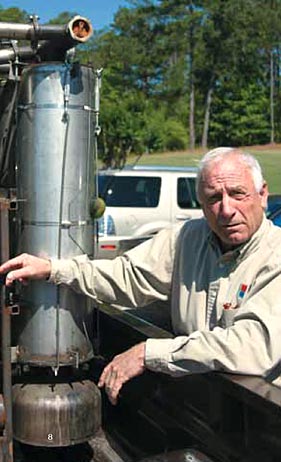
Ben Russell with a previous model of the gasifier.
(courtesy of Alabama Forests magazine) |
|





